

Introduction
Customer information management solutions are vital tools for today’s data-driven enterprises. As companies compete on experience and personalization, managing customer data efficiently and securely has become a strategic advantage.
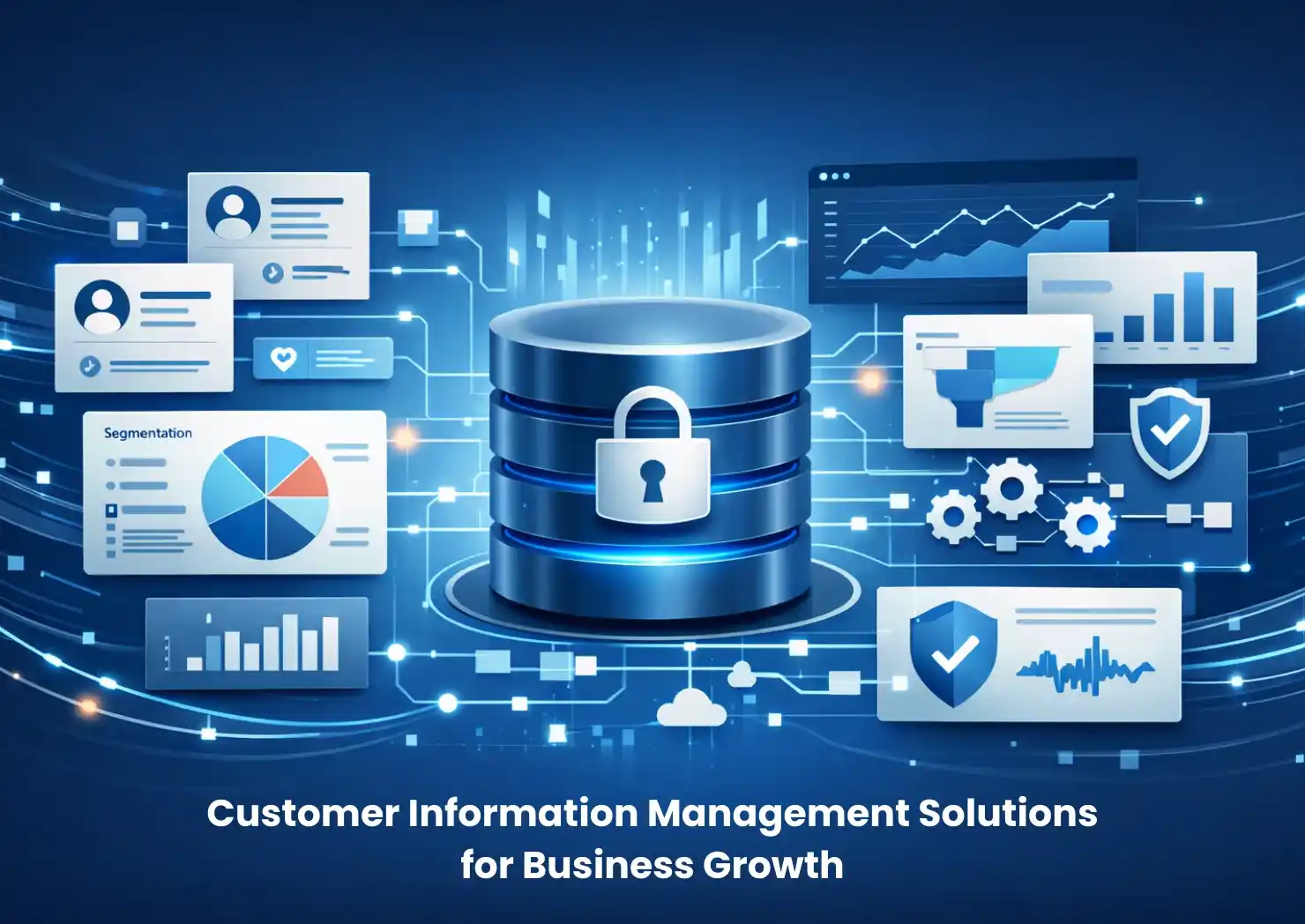
Customer information management solutions enable businesses to collect, organize, analyze, and act on customer data from disparate sources — all in one centralized system. These solutions help companies understand customer behavior, personalize engagement, and make informed decisions that directly impact growth and profitability.
However, many organizations struggle with siloed data, inconsistent customer records, and limited insights. Without a unified approach, companies face challenges such as:
- Inaccurate customer profiles
- Poor personalization
- Incomplete visibility into customer journeys
- Redundant or conflicting data sources
This is where customer information management solutions become essential — ensuring your organization has clean, reliable, and actionable customer data.
What Are Customer Information Management Solutions?
Customer information management solutions are technologies and processes used to collect, store, organize, and analyze customer data across the entire customer lifecycle.
Simple Explanation
These solutions help businesses:
- Centralize customer data from multiple systems
- Maintain accurate and consistent records
- Enable segmentation and personalization
- Analyze customer behavior and preferences
- Support strategic decision-making
Key Concepts and Terminology
- Customer Data Platform (CDP): A system that unifies customer data from all touchpoints
- Master Data Management (MDM): Ensures consistency and accuracy of core business data
- Customer Database: Repository of contact, transactional, and interaction data
- Identity Resolution: Matching customer records across systems
- Data Governance: Rules and policies for managing data quality, privacy, and access
Why Customer Information Management Solutions Matter for Businesses
Business Challenges They Solve
Customer information management solutions address several common pain points:
- Fragmented customer data across systems
- Duplicate and inconsistent records
- Limited insights into customer behavior
- Poor customer engagement due to lack of personalization
- Difficulty tracking customer journeys across channels
By addressing these challenges, organizations can generate more accurate insights, deliver personalized experiences, and improve operational efficiency.
Risks of Not Implementing Them
Without effective customer information management:
- Marketing campaigns lack personalization
- Customer support cannot access complete histories
- Decision-makers rely on incomplete or inaccurate data
- Compliance and data security risks increase
- Companies struggle to scale personalization at volume
In today’s competitive landscape, poor customer data quality can erode trust, reduce retention, and limit growth.
Key Components and Features of Customer Information Management Solutions
Centralized Customer Data Repository
A unified database that stores customer information from all channels:
- Contact details
- Purchase history
- Interaction logs
- Preferences and behaviors
Identity Resolution and Data Matching
Ensures that all data points belong to the correct customer:
- Merge duplicate records
- Link interactions across platforms
- Create a single customer view
Data Cleansing and Enrichment
Improves accuracy and completeness of customer records by:
- Standardizing formats
- Filling missing attributes
- Removing outdated entries
Segmentation and Audience Building
Enables precise targeting for marketing and sales:
- Demographics
- Purchase behavior
- Engagement history
- Lifecycle stages
Analytics and Insights
Advanced reporting and dashboards help businesses:
- Track customer trends
- Analyze lifetime value
- Identify churn risk
- Forecast customer behavior
Data Governance and Security
Ensures data is:
- Compliant with regulations like GDPR and CCPA
- Secure and access-controlled
- Audited and traceable
How Customer Information Management Solutions Work
Step-by-Step Process
- Data Collection
Aggregate customer data from websites, CRMs, support systems, transaction logs, and other sources. - Identity Resolution
Match data points to unique customer identities to create unified profiles. - Data Cleansing & Enrichment
Standardize, validate, and enhance records for accuracy. - Segmentation & Targeting
Build customer segments based on attributes and behavior. - Analytics & Insights
Analyze trends, measure KPIs, and generate reports. - Actionable Execution
Use customer data to personalize campaigns, improve service, and guide strategy.
Real-World Use Cases
- A retail brand personalizes product recommendations based on purchase behavior
- A SaaS company measures churn risk based on usage patterns
- A financial firm builds compliance-ready customer dossiers
- A healthcare provider consolidates patient data for better care coordination
Benefits of Customer Information Management Solutions
Operational Benefits
- Reduced manual data reconciliation
- Improved cross-team collaboration
- Faster access to customer insights
- Standardized processes
Customer Engagement Benefits
- Personalized communication at scale
- More relevant offers and messaging
- Faster, contextual support experiences
- Consistent interactions across channels
Business Growth Benefits
- Increased customer lifetime value
- Higher retention and repeat purchases
- Better forecasting and planning
- Data-driven strategic decision-making
Common Challenges and How to Overcome Them
Data Silos Across Systems
Challenge: Data trapped in different tools with no unified access.
Solution: Implement data integration platforms and APIs to consolidate.
Duplicate or Inaccurate Records
Challenge: Conflicting or redundant profiles.
Solution: Use identity resolution and cleansing tools.
Difficulty Segmenting Audiences
Challenge: Poor segmentation leads to generic campaigns.
Solution: Build dynamic segments based on behavior and lifecycle.
Compliance and Privacy Concerns
Challenge: Regulations like GDPR require strict controls.
Solution: Build governance policies and access controls into your solution.
Best Practices for Customer Information Management
Establish Strong Data Governance
- Define ownership rules
- Enforce data policies
- Audit regularly
Prioritize Data Quality
- Standardize data formats
- Validate incoming records
- Schedule routine data hygiene
Integrate Across Systems
- Sync CRM, marketing platforms, support systems
- Automate data flows
- Prevent data lag or gaps
Use Analytics and Reporting
- Track key KPIs like churn rate and CLV
- Monitor engagement patterns
- Make decisions based on data trends
Train Teams on Data Usage
- Provide clear data entry standards
- Educate teams on segmentation and personalization
- Encourage data-driven decision-making
Customer Information Management Solutions vs Alternatives
Customer Information Management vs CRM
Customer Information Management Solutions:
- Focus on unified data across systems
- Serve as data infrastructure for the enterprise
- Support advanced analytics and segmentation
CRM Systems:
- Focus on sales and customer lifecycle tracking
- Manage interactions with prospects and customers
- Often lack advanced identity resolution and centralization
Customer Information Management vs Data Lakes or Warehouses
Customer Information Management:
- Tailored for customer data profiles
- Supports real-time personalization
- Applies data governance and quality controls
Data Lakes/Warehouses:
- Store broad enterprise data
- Require processing for customer insights
- Not optimized for real-time engagement
When to Choose Each Option
Choose customer information management solutions if you need:
- Centralized customer profiles
- Personalization at scale
- Real-time engagement insights
Use data lakes for:
- Broad analytical use cases beyond customer data
Future Trends in Customer Information Management
AI-Powered Customer Insights
Artificial intelligence will power:
- Predictive customer behavior
- Churn prediction modeling
- Intelligent segmentation
- Automated data enrichment
Real-Time Personalization
Solutions will enable:
- Dynamic content recommendations
- Personalized emails and offers
- Real-time journey optimization
Privacy-First Data Architecture
With regulations increasing, businesses will adopt:
- Consent-driven data governance
- Fine-grained access controls
- Audit and compliance reporting
Multi-Channel Data Unification
Future systems will consolidate data from:
- Web and mobile analytics
- Social media and messaging apps
- IoT touchpoints
- Offline interactions
How to Choose the Right Customer Information Management Solution
Evaluation Criteria
When selecting a solution, consider:
- Support for real-time data syncing
- Robust identity resolution and matching
- Scalability for large datasets
- Governance and compliance features
- Reporting and analytics capabilities
What to Look for in a Provider
- Proven experience with enterprise data
- Strong integration ecosystem
- Transparent SLAs and support
- Scalable architecture
- Data security and privacy safeguards
Conclusion
Customer information management solutions are foundational to modern business success. They empower organizations to unify customer data, enhance personalization, improve decision-making, and drive growth.
By implementing the right customer information management approach, businesses can:
- Build accurate customer profiles
- Remove data silos
- Personalize customer journeys
- Optimize marketing and sales performance
- Increase operational efficiency
For companies that rely on data to engage customers and compete effectively, customer information management solutions are no longer optional — they are essential.
Frequently Asked Questions (FAQ)
1. What are customer information management solutions?
They are systems and processes that centralize and manage all customer data to provide a unified and consistent view.
2. How do these solutions improve personalization?
By creating accurate customer profiles, businesses can tailor communications and offers to individual preferences and behavior.
3. Are customer information management solutions different from CRM?
Yes. CRM focuses on sales and interactions, while customer information management focuses on data centralization and analytics.
4. What industries benefit most from customer information management?
Retail, finance, healthcare, SaaS, telecommunications, and any data-driven enterprise.
5. How do these solutions help with compliance?
They enforce governance rules, control access, log usage, and support regulatory reporting.
6. What is identity resolution?
The process of matching customer records from different sources to a single unified profile.
7. How long does it take to implement a solution?
Implementation timelines vary by scale, but most companies can go live within a few weeks to several months.







 447 Broadway, 2nd Floor, Suite 2531, New York, NY 10013, USA
 20 Wenlock Road, London, N1 7GU, UK