
Introduction
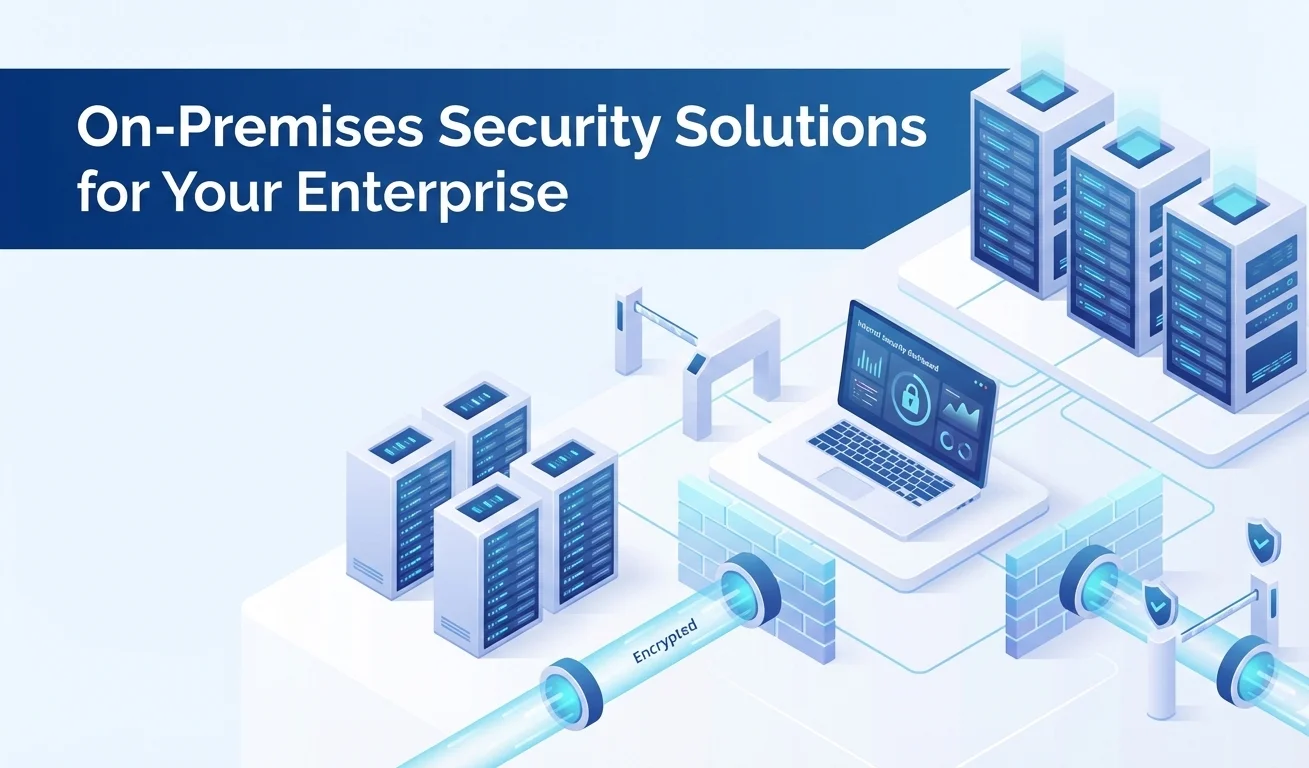
On-premises security solutions for your enterprise are becoming increasingly critical as organizations face rising cyber threats, stricter compliance requirements, and growing concerns over data sovereignty.
Unlike cloud-only security models, on-premises security solutions give enterprises full ownership and control over their security infrastructure, data storage, and access policies. This is especially important for organizations handling sensitive data, operating in regulated industries, or requiring low-latency, high-control environments.
Today’s enterprises are under pressure to:
- Protect sensitive customer and business data
- Meet regulatory and compliance standards
- Reduce exposure to cloud-based breaches
- Maintain control over internal networks and systems
For many organizations, cloud security alone is not enough. That’s where on-premises security solutions provide a robust, enterprise-grade alternative.
What Are On-Premises Security Solutions?
On-premises security solutions refer to cybersecurity systems, software, and hardware that are deployed and managed within an organization’s own physical infrastructure rather than hosted in the cloud.
Simple Explanation
With on-premises security, your company:
- Hosts security tools on internal servers
- Controls access within your own network
- Manages updates, policies, and monitoring internally
- Keeps sensitive data within your physical environment
Key Concepts and Terminology
- On-Prem Deployment: Software and hardware installed locally
- Data Sovereignty: Data remains under your jurisdiction
- Network Segmentation: Isolating network zones for security
- Physical Security: Protection of servers and facilities
- Zero Trust Architecture: Verifying every access request
Why On-Premises Security Matters for Businesses
Business Challenges It Solves
On-premises security directly addresses major enterprise concerns, including:
- Data privacy and confidentiality
- Regulatory compliance (HIPAA, PCI DSS, ISO 27001, etc.)
- Reduced dependency on third-party cloud providers
- Lower risk of external service outages
- Custom security configurations
Risks of Not Implementing It
Organizations that rely solely on cloud or minimal security controls may face:
- Increased exposure to data breaches
- Loss of sensitive intellectual property
- Regulatory penalties and fines
- Reduced control over access policies
- Higher risk of insider threats
For many enterprises, on-premises security provides a necessary layer of control and protection that cloud-only environments cannot fully match.
Key Components and Features of On-Premises Security Solutions
Network Security Infrastructure
This forms the foundation of enterprise protection:
- Firewalls (next-generation firewalls)
- Intrusion Detection Systems (IDS)
- Intrusion Prevention Systems (IPS)
- Network Access Control (NAC)
Endpoint Security
Protecting devices connected to the internal network:
- Antivirus and anti-malware software
- Endpoint Detection and Response (EDR)
- Device encryption
- USB and peripheral control
Identity and Access Management (IAM)
Controlling who can access what:
- Role-based access control (RBAC)
- Multi-factor authentication (MFA)
- Privileged Access Management (PAM)
- Directory services integration
Data Protection and Encryption
Safeguarding sensitive information:
- Full-disk encryption
- Database encryption
- Data Loss Prevention (DLP)
- Secure backups and disaster recovery
Security Information and Event Management (SIEM)
Centralized monitoring and analysis:
- Log collection and analysis
- Threat detection and correlation
- Compliance reporting
- Real-time alerts
Physical Security Controls
Often overlooked but essential:
- Secure server rooms
- Access badges and biometric controls
- Surveillance systems
- Environmental monitoring
How On-Premises Security Works
Step-by-Step Overview
- Infrastructure Setup
Security appliances and software are installed on local servers and network devices. - Policy Configuration
Security policies are customized based on enterprise requirements. - User and Device Authentication
Access is controlled through IAM and authentication systems. - Continuous Monitoring
SIEM tools monitor logs and network activity in real time. - Threat Detection and Response
Alerts trigger incident response workflows. - Audit and Compliance Reporting
Security events are logged for audits and regulatory compliance.
Benefits of Implementing On-Premises Security Solutions
Operational Benefits
- Full control over security configurations
- Custom integration with legacy systems
- Reduced dependency on internet connectivity
- Improved internal network performance
Security and Compliance Benefits
- Stronger protection for sensitive data
- Better alignment with regulatory requirements
- Lower exposure to third-party risks
- Greater visibility into internal threats
Business Growth Benefits
- Increased customer trust
- Reduced risk of costly breaches
- Stronger enterprise risk management
- Better long-term security planning
Common Challenges and How to Overcome Them
Higher Upfront Costs
Challenge: Hardware, licenses, and infrastructure can be expensive.
Solution: Use phased deployments and prioritize high-risk systems first.
Maintenance and Updates
Challenge: Internal teams must manage patches and upgrades.
Solution: Implement automated patch management and maintenance schedules.
Scalability Limitations
Challenge: Scaling requires additional hardware investment.
Solution: Use hybrid models to combine on-prem with selective cloud services.
Skill and Resource Requirements
Challenge: Requires skilled IT and security staff.
Solution: Invest in training or partner with managed security providers.
Best Practices for On-Premises Security
Follow Industry Standards
- ISO 27001 security frameworks
- NIST Cybersecurity Framework
- CIS Critical Security Controls
Implement Defense-in-Depth
Layer multiple security controls:
- Network security
- Endpoint protection
- Identity management
- Data encryption
Regular Security Audits
- Internal vulnerability assessments
- External penetration testing
- Compliance audits
Strong Access Controls
- Least privilege principle
- Role-based permissions
- Multi-factor authentication
Backup and Disaster Recovery
- Encrypted backups
- Offsite backup copies
- Tested recovery procedures
On-Premises Security vs Alternatives
On-Premises vs Cloud Security
On-Premises Security:
- Full control over infrastructure
- Higher upfront investment
- Greater customization
- Better for sensitive data
Cloud Security:
- Lower initial costs
- Easier scalability
- Managed by providers
- Less direct control
On-Premises vs Hybrid Security
Hybrid Security:
- Combines on-prem and cloud
- Offers flexibility
- Balances control and scalability
- Often ideal for growing enterprises
When to Choose Each Option
Choose on-premises if you:
- Handle highly sensitive data
- Operate under strict regulations
- Require full infrastructure control
Choose cloud or hybrid if you:
- Need rapid scalability
- Want lower upfront costs
- Have limited internal IT resources
Future Trends in On-Premises Security Solutions
Zero Trust Architecture
Enterprises are shifting to:
- Continuous authentication
- Micro-segmentation
- Identity-centric security
AI and Machine Learning
On-premises security tools are adding:
- Behavioral threat detection
- Automated incident response
- Predictive risk analysis
Converged Security Platforms
Unified platforms combining:
- Network security
- Endpoint protection
- SIEM and SOAR
- Identity management
Compliance-Driven Security
Growing regulations will increase demand for:
- Data localization
- Audit-ready security systems
- Enhanced reporting and governance
How to Choose the Right On-Premises Security Solution
Evaluation Criteria
When selecting a solution, consider:
- Security coverage and capabilities
- Integration with existing systems
- Compliance and reporting features
- Scalability and future growth
- Vendor reputation and support
What to Look for in a Provider
- Proven enterprise experience
- Strong technical support
- Regular security updates
- Compliance certifications
- Custom deployment options
Conclusion
On-premises security solutions for your enterprise provide unmatched control, customization, and protection for organizations that cannot compromise on data security and compliance.
While cloud security offers convenience, on-premises security remains essential for enterprises that:
- Handle sensitive or regulated data
- Require full infrastructure ownership
- Need customized security environments
- Prioritize long-term risk management
By implementing a well-designed on-premises security strategy, enterprises can significantly reduce cyber risks, strengthen compliance, and build a resilient security foundation for future growth.
Frequently Asked Questions (FAQ)
1. What are on-premises security solutions for enterprises?
They are security systems deployed within an organization’s own infrastructure to protect networks, data, and systems.
2. Are on-premises security solutions more secure than cloud?
They offer greater control and customization, which can be more secure for sensitive and regulated environments.
3. What industries benefit most from on-premises security?
Finance, healthcare, government, manufacturing, and enterprises with strict compliance needs.
4. Can on-premises security work with cloud systems?
Yes, many enterprises use hybrid models combining on-premises and cloud security.
5. What is the main disadvantage of on-premises security?
Higher upfront costs and internal maintenance requirements.
6. How long does it take to deploy on-premises security?
Deployment can range from weeks to months depending on infrastructure complexity.
7. Is on-premises security future-proof?
Yes, especially when combined with modern tools like Zero Trust, AI-driven monitoring, and hybrid integration.




 447 Broadway, 2nd Floor, Suite 2531, New York, NY 10013, USA
 20 Wenlock Road, London, N1 7GU, UK